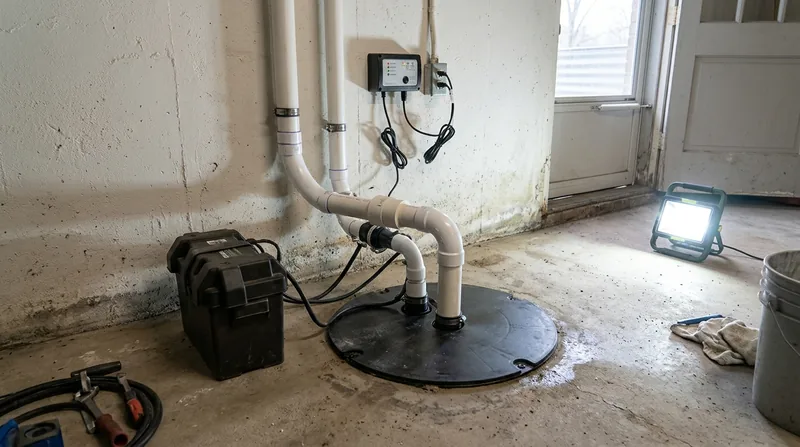




If your sump pump quits during a storm, the water in your basement rises fast. That is why Battery Backup Sump Pumps in Hammond matter more here than in most places. Hammond sits on flat glacial clay and sandy silt left by Lake Chicago, with a high water table that pushes groundwater into stone, brick and early block basements across Robertsdale, Downtown and the older east side streets. When the Grand Calumet, the Little Calumet or Wolf Lake back up after heavy rain, and the power goes out with the storm, a primary pump with no backup leaves your pit dead. We install battery backup systems sized to your pit that keep pumping when the grid drops, with alarms and maintenance checks available. If your primary pump is already aging, start with our sump pump installation and replacement page, then add the backup.
Why Battery Backup Sump Pumps Matter in Hammond's Wet Basements
Hammond's failure mode is not a slow seep. It is a storm-driven rise in the water table combined with a power outage, exactly when your primary pump is working hardest. In the 1900s to 1930s bungalows and two-flats of Robertsdale and the east side, the sump pit is often shallow and the discharge line undersized, so one long outage is enough to send water over the basement floor. In the 1940s and 1950s brick ranches and Cape Cods of Hessville, a partly finished basement means a wet floor costs you drywall and carpet, not just a mop job.
- Storms that knock out power also drive the heaviest inflow, so the backup runs when the primary cannot.
- Spring snowmelt and freeze-thaw winters keep the water table high for weeks, not hours.
- Older block walls seep at joints and open cracks under hydrostatic pressure, and the pump has to keep up.
- A battery backup with an alarm tells you the primary failed before the floor tells you.
A backup does not fix a wet basement on its own, but it buys the time you need to avoid a flooded floor.
Key info: In Hessville and the south side, we routinely find sump pits that were sized for a 1/3 HP pump and a short discharge line. A backup battery system on that pit needs the right float height and check valve, or it cycles and drains the battery before the storm is over.
For official guidance on flood readiness and power outage safety, see the Ready.gov power outage resources from FEMA.
How We Size and Install a Backup System in Hammond
We start at the pit, not at the catalog. The battery size, pump head and float setting all depend on how deep your basin is, how far the discharge line runs, and how high it lifts before it exits the wall. A split-level in Highland or a poured-concrete full basement in St. John can carry a larger basin and a longer run than a 1920s bungalow in Hammond, and the backup has to match. We test the primary pump first, because a backup on top of a failing pump just postpones the problem.
- We inspect the sump basin, the check valve and the discharge line for clogs, freeze risk and backflow.
- We measure the lift and run, then match the backup pump and battery capacity to that head.
- We set the float so the backup starts only after the primary has genuinely failed.
- We wire the charger and alarm, then run a live test with the primary breaker off.
- We walk you through the alarm and the maintenance check schedule before we leave.
If the inspection shows the real problem is hydrostatic pressure at the cove joint, we say so and point you to an interior drain tile system instead of selling you a bigger battery.
Local example: A foursquare near Wolf Lake had a primary pump that ran fine in dry weather but tripped the breaker during summer storms. We replaced the check valve, corrected the discharge line grade and added a battery backup with an alarm. The next outage, the backup carried the pit for six hours without a wet floor.
Backup Options We Install and What Each One Handles
Not every basement needs the same hardware. A shallow pit in a 1950s Hessville ranch and a deep poured basin in a 2000s Schererville subdivision call for different battery capacities and pump head ratings. Here is how the common approaches compare in Hammond conditions.
| Approach | Description | Best for |
|---|---|---|
| Battery backup pump in the same basin | A DC pump and battery mounted beside the primary, sharing the pit and discharge line. | Most Hammond basements with a working primary and a standard pit. |
| Backup with dedicated discharge | Separate line and check valve so the backup cannot backfeed the primary. | Older east side homes with a long or undersized existing line. |
| High-capacity battery bank | Larger AGM or lithium battery for multi-day outages and deeper pits. | Low corners and high water table blocks near the Calumet rivers. |
| Alarm and monitoring add-on | Float alarm and charger status light so you hear about a failure early. | Finished basements and homes left empty during winter. |
We match the option to your pit and your outage history, not to a package deal.
Battery Backup Sump Pumps Cost in Hammond: What to Expect
Most battery backup installations in Hammond start from $900, and that figure covers a standard DC backup pump, a battery, the charger, the float and a live test in a typical pit. The number moves up when the pit is shallow and needs rework, when the discharge line has to be rerun, or when you want a high-capacity battery bank for multi-day outages. A dedicated discharge line and a monitoring alarm add to the job, and so does correcting a check valve that is stuck or installed backward.
- Pit depth and condition: a cracked or undersized basin adds liner or replacement work.
- Discharge run and lift: a long run to the exterior wall needs a stronger pump head.
- Battery capacity: a standard battery covers a short outage, a larger bank covers days.
- Alarm and monitoring: an add-on that pays for itself the first time the primary fails quietly.
Get two or three estimates and ask each contractor to state the pump head, the battery capacity and what happens to the old check valve. Our full pricing overview shows how the line items break down.
Choosing a Waterproofing Contractor Near Hammond: What to Check
Battery backup work is small enough that almost anyone will quote it, so the vetting matters. Ask for the license and insurance certificate before work starts, and confirm the quote names the pump model, the battery capacity and the alarm. Call two past customers in Hammond or a neighboring city and ask whether the backup actually ran during an outage. If the job touches the discharge connection to the sanitary line, ask who pulls the permit, because rules vary by jurisdiction and the local building department has the final say.
Start with a free estimate and we will tell you plainly whether a backup is enough or whether the wet basement needs drain tile first.
Battery Backup Sump Pumps in Hammond: Pricing Guide
| Service | Price | Details |
|---|---|---|
| Standard battery backup installation | Starting at $900 | Includes DC backup pump, battery, charger, float and live test in a standard pit. |
| Backup with dedicated discharge line | Starting at $1,250 | Adds a separate discharge run and check valve so the backup cannot backfeed the primary. |
| High-capacity battery bank | Starting at $1,450 | Larger AGM or lithium battery sized for multi-day outages and deeper sump pits. |
| Alarm and monitoring add-on | Starting at $150 | Float alarm and charger status light installed with the backup system. |
| Complex or large-scale job | On estimate | Pit replacement, discharge rerouting or combined work needs an on-site look first. |
| Estimate | Free | Response within 24h at (219) 228-8921, no obligation to book. |
Indicative pricing, the exact cost depends on square footage, finish, and site access. Free personalized estimate within 24h at (219) 228-8921.


