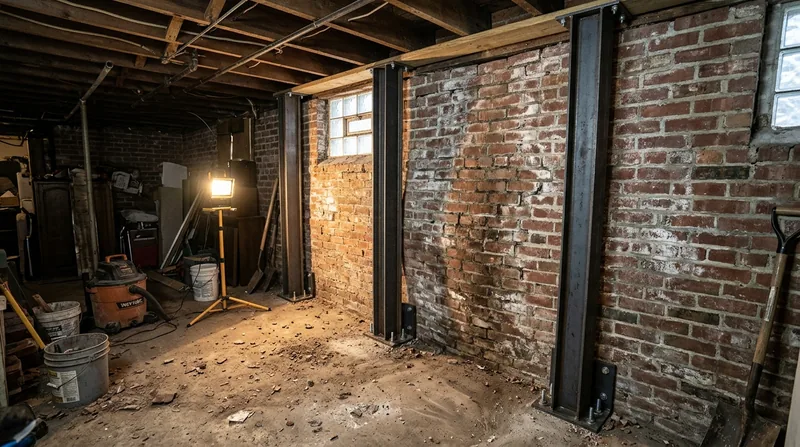




Bowing wall repair in Hammond starts with understanding what the ground is doing to your foundation. Most of this city sits on flat glacial lake clay and sandy silt left by Lake Chicago, with a water table that stays high and pushes against basement walls all year. In Robertsdale and the older east side streets, that pressure works on stone, brick and early block walls that were never designed for it. After a hard freeze and a wet spring, we see walls in Hessville and the south side lean inward a half inch or more in a single season. We stabilize the wall and address the soil pressure behind it, and we tell you plainly when a wall only needs monitoring. Start with a free basement inspection so we can measure the movement instead of guessing.
Why Bowing Walls Are Common in Hammond's Older Basements
Hammond's building stock tells the story. The 1900s to 1930s frame bungalows, two-flats and foursquares in Robertsdale, Downtown and the older east side streets have full basements built with stone, brick or early block. Those walls are thick but brittle, and they have spent a century holding back wet clay. When the Grand Calumet and Little Calumet rivers and Wolf Lake back up after heavy rain, the water table rises and hydrostatic pressure loads the wall from the outside. The 1940s and 1950s brick ranches and Cape Cods in Hessville and the south side show the same pattern, often with a partly finished basement hiding the first cracks.
- Horizontal cracks in the middle third of a block wall are the classic sign of soil pressure, not settlement.
- A wall that leans inward at the top is usually being pushed by saturated soil and a failing footing drain.
- White efflorescence and a musty smell mean water is moving through the wall even when the floor stays dry.
- Doors and windows that stick on one side of the basement often track a wall that is moving.
If you see any of these, get the wall measured before the next freeze-thaw cycle moves it further.
Key info: On a 1920s brick foursquare near Downtown Hammond, a horizontal crack at mid-wall plus a one inch lean at the top pointed to hydrostatic pressure from a dead footing drain, not to a failing foundation. We stabilized the wall and corrected the drainage instead of excavating the whole perimeter.
For the rules that apply to structural foundation work in Hammond, verify current requirements with the City of Hammond building department before any repair is scheduled.
How We Stabilize a Bowing Wall in Hammond
We do not sell one method to every wall. The right fix depends on how far the wall has moved, what the wall is made of, and how much water is sitting in the soil behind it. A poured concrete wall in a 1990s Schererville subdivision behaves differently from a 1930s block wall in Whiting. We measure the deflection, check the wall for cracks and efflorescence, and look at the drainage before we recommend carbon fiber, steel or anchors. If the wall has not moved past a safe limit, we say so and monitor it.
- We inspect the full wall from inside and check the exterior grade, downspout extensions and window wells for water loading.
- We measure the horizontal deflection and mark reference points so the movement can be tracked over time.
- We identify whether the cause is soil pressure, a failed footing drain or both, because stabilizing a wall without fixing the water rarely holds.
- We install the selected system, carbon fiber straps, steel I-beams or wall anchors, and tension it to the wall's actual condition.
- We correct the drainage that caused the pressure, often with an interior drain tile system tied to a sump basin.
- We re-measure the wall and leave you a record of the starting point for future checks.
Every job ends with a written summary of what moved, what we installed and what to watch.
Key info: A 1950s brick ranch in Hessville had a block wall bowing two inches after a wet spring. Carbon fiber straps alone would have masked the problem, so we paired them with a sump and discharge line to relieve the pressure. The wall has held its position through two winters since.
Bowing Wall Repair Methods We Use
Each method addresses a different severity and a different wall type. We match the system to the movement, not to a sales target, and we explain the trade-offs before you commit.
| Approach | Description | Best for |
|---|---|---|
| Carbon fiber straps | Straps bonded to the wall from floor to ceiling to stop further inward movement. | Block or concrete walls with moderate bowing and no top lean. |
| Steel I-beams | Vertical steel beams anchored in the floor and secured to the joists. | Walls with heavier movement or a lean that needs positive restraint. |
| Wall anchors | Plates set in the exterior soil tied to interior wall plates to pull the wall back. | Walls that can be straightened rather than only held in place. |
| Drainage correction | Interior perimeter drain, sump and discharge to relieve hydrostatic pressure. | Any bowing wall with wet soil, efflorescence or a failed footing drain. |
Most Hammond jobs combine one structural method with drainage correction, because the pressure has to go somewhere.
Bowing Wall Repair Cost in Hammond: What to Expect
Pricing for bowing wall repair in Hammond starts at $600 for a limited stabilization scope, such as a small number of carbon fiber straps on a wall with minor movement. Most full wall jobs land well above that, and the range is wide because the work is driven by the wall. A single wall in a Griffith ranch is a different job from a full perimeter in a foursquare near Downtown. We give you a number after we measure, not before.
Several factors move the price. The length and height of the wall set how many straps or beams are needed. The wall material matters, since old brick and stone take more prep than poured concrete. Access to the basement and the exterior soil affects labor. If the drainage has to be corrected at the same time, that adds scope. And if the wall has moved past the point where straps will hold, anchors or beams cost more than a simple strap job.
Get two or three estimates and compare the scope, not just the total. A low number that skips the drainage usually comes back as a second repair. Our full pricing overview lays out how we build an estimate.
Choosing a Bowing Wall Repair Contractor Near Me in Hammond
This is structural work, so the contractor matters as much as the method. Ask for the license and insurance certificate before work starts, and confirm the policy covers foundation and structural repair. Get at least three written estimates that state the method, the number of straps or beams, and whether drainage correction is included. Ask for references from jobs in Hammond or a neighboring city with the same wall type, and call them. Permits are commonly required for structural foundation repair in this region, and the rules vary by jurisdiction, so confirm with the local building department which permits your job needs and who pulls them. If your property is in a subdivision with association rules, check those before exterior excavation begins.
Reach out through our contact page to set up the inspection.
One more check: ask whether the contractor measures the wall before and after. A repair without a measurement is a guess.
Bowing Wall Repair in Hammond: Pricing Guide
| Service | Price | Details |
|---|---|---|
| Carbon fiber strap stabilization | Starting at $600 | Covers a limited strap count on a wall with minor movement; wall length and strap number move the price. |
| Steel I-beam wall stabilization | Starting at $1,800 | Includes beam set and anchoring; wall height, beam count and basement access drive the final figure. |
| Wall anchor system | Starting at $2,500 | Covers anchor plates and tensioning; exterior soil access and wall length are the main cost factors. |
| Structural repair with drainage correction | On estimate | Combines wall stabilization with interior drain tile and sump; needs an on-site look before pricing. |
| Travel | Included | In Hammond and surrounding areas, with no separate call-out or mileage fee added. |
| Estimate | Free | Response within 24 hours at (219) 228-8921, with no obligation to book the work. |
Indicative pricing, the exact cost depends on square footage, finish, and site access. Free personalized estimate within 24h at (219) 228-8921.


